2019 BIMsystems Ux strategy workshop
It was beginning of the year and we had just past our biggest working commitment effort on October, to showcase our new product ideas in a congress hall and get the investment needed to continue growing. I had been working in BIMsystems for the last 6 months and suddenly I had the feeling we were all exhausted and how no idea where to go next.
The topic of UX Strategy was for me first heard by Lea Bulley on the User Experience team of one. As she said “when your team seams a lacking of a unified vision and goal, it is time for organizing a strategy workshop.” So I started to research how do usually ux designers make a strategy workshop, if there are any guidelines or activities suggested. I had a look at the design sprint in search for activity ideas, but most were oriented to define a new product and not to set a ux strategy. I also read some of the definitions about ux strategy, for example the one from Jamie Levy. She gave me the grounding ideas about the topics we should discuss, but her focus was on long term strategy and I wanted a short kick off before structuring the whole year´s work.
So I decided to develop my own workshop. It was a mishmash of many things I already learned and could apply to the following challenge: to have a clear team vision of where and how our product should evolve in 2019.
The method
- Where are we? what products do we have, what can users actually do with them right now?
- Where do we want to go? Which user groups do we want to focus on, what is our value proposition for each product, what things we need to care so that we are profitable?
- How do we reach our goals? Which key results we should focus on and which key experiences should be definitely in our roadmap.
The participants
I decided to invite to this workshop different perspectives of the company. We were 5 participants: the product owner, the 2 developer leads, our marketing guy and me. At this point I must say the size was optimal for our workshop, we had very different perspectives, but one mistake was made: not having Sales person on the workshop. I still regret about this, and I will not make the mistake of not having someone from sales next time. Is key to keep sales needs very close to product innovation team, so that roadmaps are defined with both needs addressed.
The agenda
Where are we?
- Mapping Product Features Status (20min)
- Mapping Target groups (10 min)
- Fake Personas (30 min)
Where do we want to go?
- Lightning Demos: Value proposition of our competitors & How might we differentiate from them? (30 min)
- Value Propositions/ design the box (30 min)
- Review of Business objectives and key results and how might we achieve them (30min)
- Value innovations: key experiences in product boxes (30 min)
How do we reach our goals?
- Roadmap for initiatives 2019 (1 hour)
- Mapping key results in Roadmap (20mins)
Outcomes
Mapping the products
The biggest outcome of the first section of our workshop was a mapping of our product branches and a progressive description of their qualities now and the goals for 2019.
-At the very top we gave the name of the products. This was the first activity to place together the names of the products we had. There we found our first issues, we had no commercial names for products and some products and more a technical grouping.
-The second line corresponds to the activity of mapping the target groups. Each participant prepared their own target group names and then added them to the different products. At this point we started to notice some products features should become separate products as they were meant for different target groups and other products were clustered together as satisfying a same user group.
-The third line was a joint discussion, what is the status of the development until now for the products independently of the design concepts and showcases made. This activity was a back to earth intent and was specially valuable for marketing as sometimes we tent to forget what we are when we try to sell what we want to be. It was a realisation of the amount of work we had upon us to achieve the things we had already promoted.
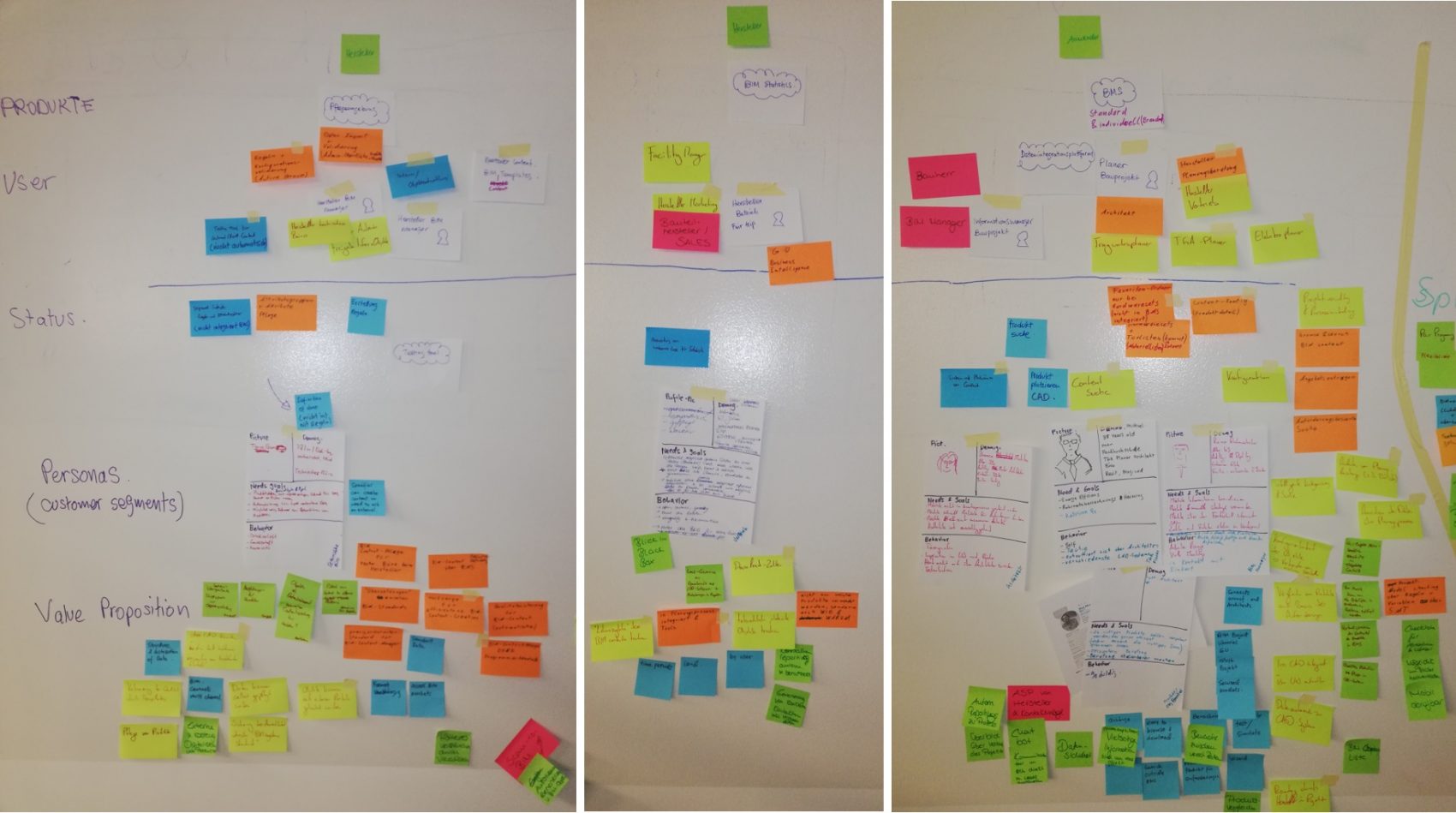
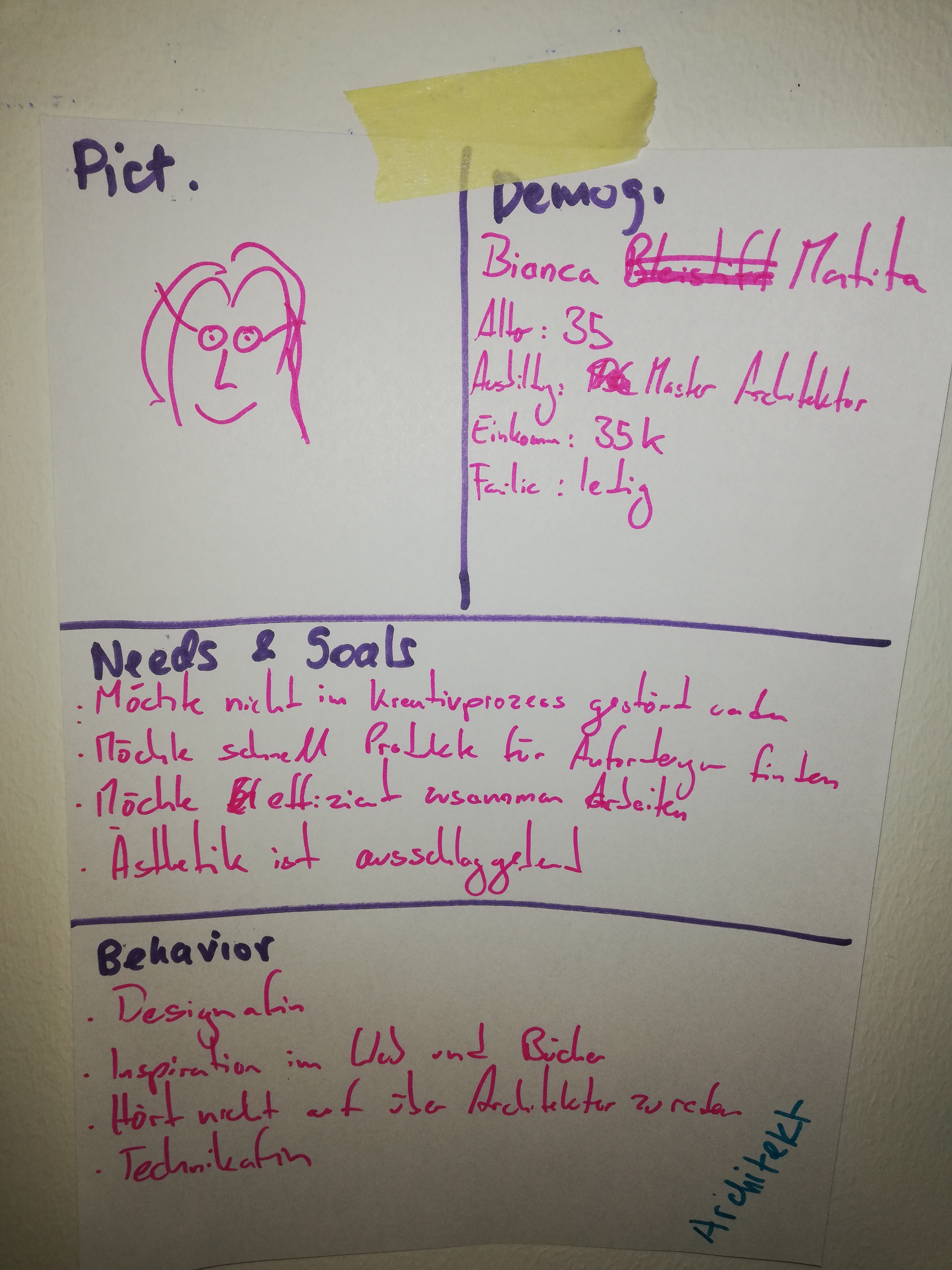
-On the next activity my purpose was to collect all the information we as a team already knew about our users, summarize it as proto-personas, which we would during this year progressively get to know better. Each participant had the job to collect from others all the information about this persona, summarize it and present it. Also the activity intended to bring the participants to empathize with the product target groups on the next activities.
Here an example of one of our proto-personas:
-Finally, I presented selected images from competitors webpages where they described the value proposition of similar products as we had. During this activity participants were asked to take notes and about “how might we differenciate from other products in the market?” This value propositions were also mapped per product branch.
Designing the Box
After an activity phase where we collected a lot of information and were in a brainstorming mode, it was time to synthethise, summarize and bring a comon focus to continue on a “prototyping” step where we would sketch our roadmap. During a workshop of service design thinking from the XDI I learned a very charming activity to summarize unique value propositions of product, it is called “Design the Box” (Gamestormming). I thought this was the perfect way to make tangible our goals so this was the second block of our workshop outcomes. We separated in 3 teams, each for a product branch and use the structure of a product box to fix the the UVPs of each product. This is how they looked:

At the front of the box each team should place the name of the product. Directly under the name they should right the main value proposition of this product in a short sentence. On one of the sides of the box they will list the target groups for this product, then on the back, the key features for each product (what special things the target groups could achieve by using this product).
Setting priorities
When we were finished the box activity, we had a visual focus on what innovations we should focus on this year. But as we all know, building products has also risks and business goals to fulfill. This gave us another perspective to set our priorities, which product features could guarantee our sustainability? Which will be totally important to continue being an innovative business? We ranked the the experiences and also added some notes for additional operative work we definitely needed to be done. At this point we were ready to start building our roadpmap.
Roadmap
A roadmap is a very delicate topic in product development. No one wants to make fixed commitments about unknown work without effort estimations. By the other side, for sales and marketing it is a indispensable to know what the will be selling the next months, else they can´t plan campaigns. So it was important to make this roadmap flexible enough to adapt to changes and still reflect our vision and our commitment to continue being profitable.
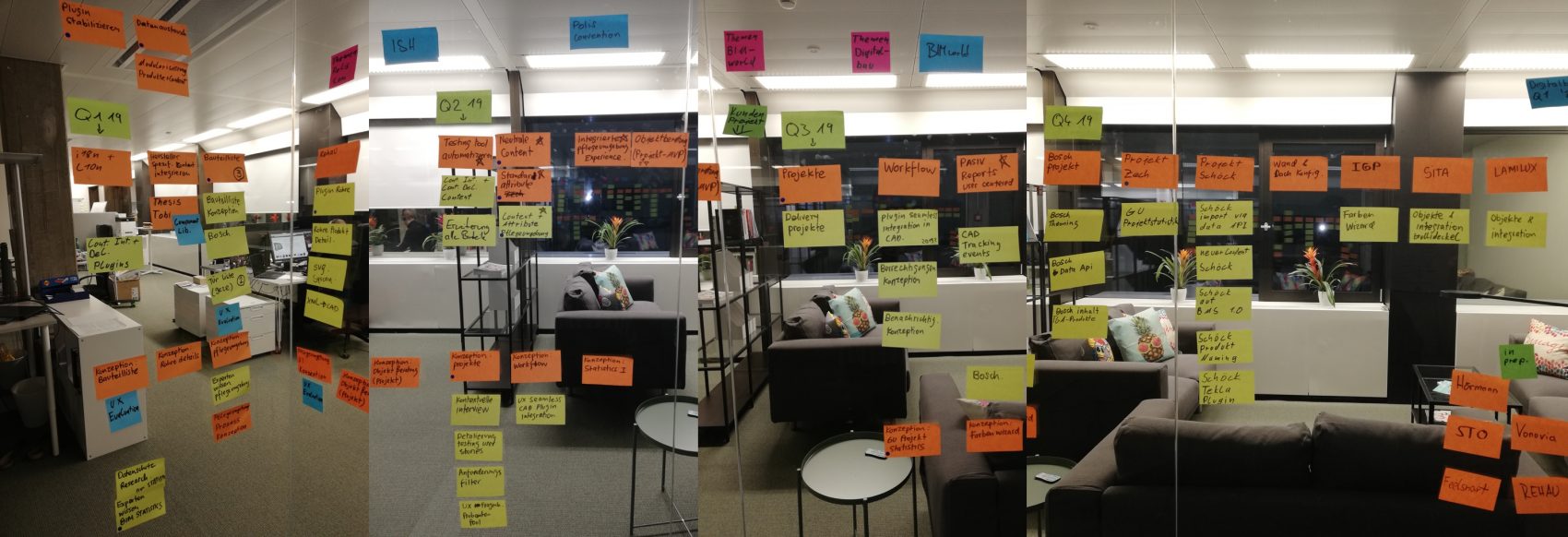
The roadmap activity was a split by roles. First the product owner created a section for each year quartal. And placed the key features of the different products as he though they should follow. Then the developers added post its on what needed to be done in order to build this key features and adapted the dependencies and order, then marketing brought the perspective of the showcases and events where we had deadline for presenting our innovations and then we all added operative tasks that were needed for us to survive as a business (finishing contracts with clients, improving processes to be faster in repetitive work).
I find very interesting to look back at this workshop, precisely now, at the end of 2019! At this point I can tell, this workshop brought us a lot. The motivation of the team was very high afterwards, we had a common focus, marketing started to created real product identities and prepare the market for them, we knew also our risks and how we should do to solve them. In many aspects this plan was followed, other new opportunities were also found in the way and the plan was adapted.